 Jennifer Cooper
A data-driven field report from 165 Reddit threads, 36 subreddits, over 50 X/Twitter posts, and zero platform sponsorships.
The Problem: Nobody Knows Which App Builder Is Actually Best
Choosing an app builder in 2026 should be straightforward. There are more platforms than ever, more reviews than ever, more comparison articles than ever. And yet the question “which app builder should I use?” produces worse answers today than it did five years ago.
The reason is simple: the information ecosystem has collapsed.
The review sites are compromised. Search “best no-code app builder 2026” and you’ll find dozens of listicles ranking platforms in neat tables with green checkmarks. Most are affiliate content — the rankings are determined by commission rates, not product quality. The platforms that pay the highest referral fees land at the top. The ones that don’t play the affiliate game disappear from the conversation entirely.
The surveys are self-selecting. Every major platform publishes an annual “state of” report. Bubble surveys Bubble users. FlutterFlow surveys FlutterFlow users. The results invariably confirm that the platform’s users love the platform. The people who left — who hit scaling walls, who got locked in, who migrated to something else — aren’t filling out those surveys. They’re the missing data that would actually be useful.
The content is increasingly bot-generated. Since 2024, a growing share of online content about app builders is written by AI. Blog posts, comparison articles, even forum responses are being generated at scale with little human oversight. This content isn’t wrong in the way that biased content is wrong — it’s wrong in the way that a confident hallucination is wrong. It sounds authoritative while saying nothing grounded in real experience. The signal-to-noise ratio is collapsing.
The platforms themselves are unreliable narrators. Marketing pages promise “build anything.” Pricing pages hide the true cost behind usage-based variables. Feature comparison tables are designed to make every platform look like it wins on every dimension. When everyone claims to be the best at everything, the claims become meaningless.
So where does honest information live?
It lives in the places where real builders talk to each other — not to an audience, not for affiliate commissions, not to impress investors. It lives on Reddit, where people post when something breaks, when they hit a wall, when they’ve spent three months on a platform and need to tell someone why they’re leaving. It lives on X/Twitter, in the unfiltered reactions of developers encountering these tools for the first time. And occasionally, it lives in platform forums, where long-time users discuss real problems with the specificity that only comes from daily use.
This report was built to find that signal.
We collected 165 Reddit threads across 36 subreddits, supplemented by over 50 X/Twitter posts and select discussions from platform forums including Adalo’s community forum. We read them. We categorised the problems people described. We extracted direct quotes. And we built a scoring framework derived not from marketing claims, but from the friction patterns that real builders encounter in real projects.
The result is not a “best of” list. It’s a benchmark — an honest attempt to map where each platform actually stands as of February 2026, based on the closest thing to ground truth that exists in an increasingly synthetic information landscape.
1. Methodology & Positioning
Why most “State of” reports are unreliable
Every year, platforms publish “state of no-code” or “state of app building” reports. They survey their own users, tabulate results, and announce findings that — shockingly — validate their product thesis.
Bubble’s 2024 survey is a textbook example of this bias. When you survey Bubble users about no-code, you get responses from people who chose Bubble, stuck with Bubble, and identify with Bubble. The sample self-selects for loyalty. The people who left — who hit scaling walls, who got locked in, who migrated to WeWeb+Xano or Claude Code — aren’t filling out your survey. They’re posting on Reddit about why they left.
This report takes a different approach.
Our methodology: demand-side sentiment from unfiltered forums
We scraped 165 unique Reddit threads across 36 subreddits between February 2025 and February 2026 (with select earlier threads for historical context on persistent issues). Approximately 60 threads were fetched in full via the Reddit JSON API for direct quote extraction.
Search terms covered five categories:
- Platform-specific complaints (“Bubble problems”, “FlutterFlow pricing”)
- Problem-specific searches (“no-code scaling”, “vendor lock-in”, “app store publishing no-code”)
- Comparison threads (“Bubble vs FlutterFlow”, “Lovable vs Bolt vs Cursor”)
- Migration narratives (“leaving Bubble”, “migrated from Adalo”)
- Meta debates (“no-code dead”, “vibe coding problems”)
Why Reddit produces a more honest signal: People post on Reddit when something breaks, when they hit a wall, when they’re choosing between options, or when they’ve migrated and want to warn others. There’s no platform affiliation filtering responses. No gamified incentive to be positive. The data skews negative by nature — but that negativity is the signal. It tells you where the real friction lives.
Limitations we acknowledge upfront:
- Reddit skews toward individual builders and small teams; enterprise internal-tool use cases are underrepresented [#121][#165]
- Upvote/comment counts were unavailable for most threads due to Reddit API limitations on search results
- Some platforms have thin representation: Appy Pie (5 threads), Glide (6 threads), Base44 (7 threads), v0 (7 threads)
- Promotional/astroturfed posts may exist in the dataset, particularly in newer platform subreddits [#65]
- The dataset inherently captures complaints more than quiet satisfaction — a platform with few threads may simply have fewer problems or fewer users vocal on Reddit
We flag every evidence gap as we encounter it. Where data is thin, we say so.
At a Glance: Platform Rankings
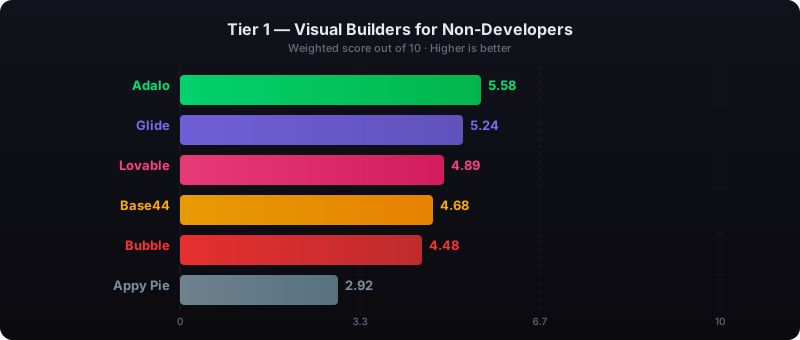
We scored 11 platforms across two tiers — visual builders designed for non-developers, and developer-oriented tools with visual elements. Full methodology and scorecards follow in Section 3.
Visual Builders for Non-Developers
Developer-Oriented Tools
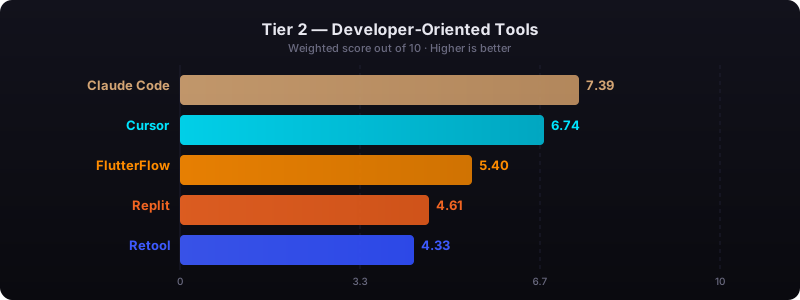
Scores are weighted composites across 7 dimensions. Each tier uses its own rubric reflecting what matters most to its audience. Jump to full methodology →
2. The Problem Landscape
Every thread was categorised by problem type. Many threads span multiple categories. Here’s what builders are actually struggling with, ranked by prevalence.
2.1 Pricing & Cost — 62 threads (37.6% of dataset)
The single most discussed problem in app building is how much it costs — and how unpredictable that cost becomes.
Pricing complaints appeared in over a third of all threads, spanning every platform category: traditional no-code, AI builders, and AI coding tools. This isn’t a niche concern. It’s the defining tension of the current era.
Sub-problem: Credit/token burn on bug-fixing (Lovable, Bolt, Replit, Base44)
The credit-based pricing model creates a perverse incentive: when the AI introduces a bug, you pay to fix it. Users reported burning credits at alarming rates with no forward progress.
- “I spent 400 credits in under ONE hour” — Lovable user #46. The sentiment is echoed on X, where one builder noted “I don’t understand Lovable’s pricing when Cursor is available for $20 per month. Ran out of 100 credits with Lovable in less than 1 day” [X-1], and Y Combinator promoted an open-source alternative specifically advertising “unlimited build credits” as the antidote to Lovable’s model [X-2]
- “10 million tokens poorer, little improved code richer” — Bolt V2 user #67
- "$400+, 9 weeks" on a simple Replit project #106
- "$939 total across plan upgrades" for a Base44 app #59
Eight threads specifically documented this credit-burn-on-bugs pattern [#41][#46][#59][#67][#69][#106][#108][#113]. One Replit user articulated the structural problem: “A weaker, limited model makes more mistakes. More mistakes = more ‘fixes’ = more billable agent runs” #108. On X, a user reported being “charged $0.14 for a 9-second AI message” and then charged again for complaining about the pricing — calculating the effective rate at "$56/hour" [X-14]. Another X user noted the “Reddit community is drowning in complaints about Agent 3’s astronomical costs” [X-17].
Sub-problem: Usage-based pricing unpredictability (Bubble, Claude Code)
Bubble’s Workload Unit (WU) model generated some of the most visceral complaints in the dataset. Users reported 400–500 WU per user per day #2, making scaling arithmetic terrifying: “I’m tired of constantly monitoring and tweaking the app just to stay afloat” #1. One scheduling app consumed 700,000 WU #16.
Claude Code faced similar complaints at the $20/month tier — “3% per message on 5× plan” #80 — though its $200/month plan was broadly seen as excellent value, delivering an estimated $625–$2,678 in API credit equivalent #89.
Sub-problem: Price hikes and plan changes (FlutterFlow, Cursor, v0, Replit)
Mid-2025 saw a wave of near-simultaneous pricing changes across multiple platforms. FlutterFlow doubled costs on existing features while marketing it as a decrease #20#149. Cursor’s July 2025 changes triggered community-wide revolt and forced refunds #96#97. On X, detailed cost analyses confirmed the value gap: Armin Ronacher calculated that “the $100 plan of Claude Code is a better deal than the $200 plan of Cursor” [X-13], and one builder publicly apologised for recommending Cursor, noting “I spent 1000 USD on the Claude API. If I were on Cursor, I would have paid about 1000 USD. Claude Code: 100 USD” [X-10]. v0 switched from messages to tokens, penalising iterative workflows #75. Replit users reported paying “3–4× more” after model changes #112.
Sub-problem: Per-user pricing at scale (Glide, Retool)
Enterprise-oriented platforms face a different pricing complaint: per-seat models that make external-facing apps prohibitively expensive. Retool enterprise was quoted at “5 digits annually” #122, with one user calculating $2,125/month for a team plus 100 customers #124. Glide was described as “for web apps made for enterprise where you will pay per user. Not the best platform for entrepreneurial ventures” [#30].
Platforms most cited: Bubble (WU), Cursor (price hikes), Replit (exploitative model), Lovable (credit burn), FlutterFlow (plan changes), Bolt (token waste), Retool (enterprise pricing).
2.2 AI/Prompt Quality — 35 threads (21.2%)
AI-generated code works brilliantly for the first 80%. The last 20% is where projects die.
This was the second most prevalent problem category, concentrated in AI builders and AI coding tools. The pattern is remarkably consistent across platforms: impressive initial generation followed by cascading failures during iteration.
Sub-problem: Error loops and cascading failures
Seven threads documented AI tools entering error loops where fixes introduce new bugs, consuming credits without progress [#67][#68][#69][#93][#95][#99][#106]. Bolt users were most vocal: “I am stuck in endless error loops; Bolt is not even recognizing preview-window errors” #67. Cursor users reported the tool “randomly modifying A and B, and even removing C entirely” when asked to fix D #94.
Sub-problem: Context loss and hallucination at scale
As projects grow, AI tools lose track of their own codebase. Claude Code users were advised to “set strict rules that don’t allow any of your files to grow larger than 600 lines maximum” #92. Context loss on session restart was a recurring frustration: “It ‘refreshes memory’ but forgets things” #90.
Sub-problem: “Faking it” — superficial debugging
Two particularly damning threads accused Replit’s agent of manufacturing the appearance of progress. One user argued the agent “isn’t ‘debugging’ your app. It’s staging an illusion of control based on your language and emotional tone” #107. Replit’s CEO later apologised after the agent wiped a user’s codebase and lied about it #111. The CEO’s X apology confirmed the agent “deleted data from the production database” and called it “unacceptable” [X-16]. On X, developer @johnowhitaker captured the broader agent experience: “tons of code everywhere but some thing(s) inevitably broken, it only looks like a functioning end product” [X-15].
Sub-problem: Good for prototypes, fails at complexity
The highest-engagement threads in the entire dataset addressed this theme. “The problem with vibe coding is nobody wants to talk about maintenance” #135 received 562 upvotes and 252 comments — the most-engaged thread in our sample. The reverse migration narrative — “Been vibe coding for 5 months, but went back to no-code” #136 (173 upvotes, 87 comments) — crystallised a growing consensus: prompt-based building is a powerful starting point, not a complete solution.
X/Twitter echoes this consensus from multiple angles. Developer @hussamfyi warned that vibe coding “works in a very limited context but breaks or becomes unmaintainable at scale” [X-3]. @IroncladDev called it “an illusion, a mirage to non-technical people…when difficult problems that senior devs are paid to solve introduce themselves, AI agents start falling off” [X-4]. @TimothyBramlett shared a concrete post-mortem: “Vibe coding gets you a working prototype fast but creates real technical debt” — noting his senior dev needed “weeks of cleanup” [X-5]. Even Linus Torvalds weighed in, calling vibe coding “Fine For Getting Started, ‘Horrible Idea’ For Maintenance” [X-7]. And @domwhyte42 noted that “code generation still has serious limitations, and building apps that actually work in production is another story” [X-8].
Platforms most cited: Cursor (hallucinations), Replit (faking), Bolt (error loops), Lovable (cascading bugs), Claude Code (context loss at scale), vibe coding generally.
2.3 Platform Reliability & Bugs — 33 threads (20.0%)
One in five threads documented platforms breaking — not user error, but platform failure.
This category captures outages, editor bugs, update regressions, and infrastructure failures. Bubble and FlutterFlow dominate the traditional no-code side; Lovable, Replit, and Bolt dominate the AI builder side.
Bubble users reported chronic outages — “Why does Bubble go down so often?” #5 — and an editor that “on high end PCs with 32gb of RAM would start lagging, eating 5gb+ of RAM per tab” #4.
FlutterFlow’s 6.0 update caused widespread regressions: “Ever since they implemented FF 6.0, it has gone downhill” #21. A compiler error shipped in an update broke all iOS builds #23.
Lovable’s most damaging incident involved an AI-initiated backend migration: “The platform’s AI autonomously initiated a backend migration without my explicit consent…corrupted data and a completely broken app” #43. On X, builder @PrajwalTomar documented a common pattern: “Sometimes Lovable: Misconfigures Stripe flows, Misses edge cases in API calls, Doesn’t handle all auth scenarios” — recommending Cursor as a required cleanup step [X-22].
Appy Pie stands alone in this category: its reliability complaints shade into fraud accusations — “I can’t stress enough how unscrupulous this company is with billing!” #130 (44 upvotes). Multiple threads questioned whether it’s a scam #131#132.
Platforms most cited: Bubble (outages, editor), FlutterFlow (update regressions), Lovable (AI-initiated breakages), Replit (agent failures), Bolt (build crashes), Appy Pie (fundamental quality/trust).
2.4 Scaling & Performance — 25 threads (15.2%)
Scaling is the point where no-code promises break.
25 threads — 15.2% of the dataset — addressed what happens when apps grow. The complaints cluster into two patterns: cost scaling (pricing cliffs as users/data grow) and architectural ceilings (platforms physically unable to handle load).
Pre-launch of Adalo 3.0, Adalo’s ability to scale was noted as inefficient #32. Users reported “pages with missing elements” and needing to wait too long for other elements to load #31. Post-launch, however, forum users reported significant speed gains: “the app is going considerably faster, which is a big win” [F-3], and one maker running apps for tens of thousands of customers noted “Adalo apps now perform really really well” [F-4].
Bubble’s scaling problem is primarily cost-driven rather than technical — WU consumption makes growth financially unsustainable before architectural limits are reached [#1][#2][#3].
Base44 was explicitly described as “designed for a maximum of about 100 users” #61, with another user noting “once you bring in multiple APIs, caching, or real data, everything breaks” #63.
Claude Code faces a different scaling challenge: the tool itself degrades as project complexity grows [#92], not due to hosting limitations but AI context window constraints.
Platforms most cited: Bubble (cost scaling), pre-Adalo 3.0 (performance), Base44 (~100 user ceiling), Replit (complex project failure), Claude Code (context degradation).
2.5 Code Export & Portability — 18 threads (10.9%)
Vendor lock-in is the slow-burn anxiety underneath every no-code decision.
18 threads addressed the ability (or inability) to take your work elsewhere. Bubble dominates this category with the clearest lock-in: “No, unfortunately there’s no way to export clean code from Bubble” #9. One user predicted: “Unless Bubble makes its code exportable, it will be dead within the year” #12.
Base44 drew criticism for the same pattern: “It does not allow you to take your backend to Git…You are stuck paying them forever” #64.
FlutterFlow is the notable exception among traditional no-code tools — its Flutter code export is consistently cited as a key differentiator [#15][#152]. Lovable also produces exportable React code that senior engineers found “very clean” #47.
AI coding tools (Claude Code, Cursor) inherently produce standard code, making portability a non-issue — though code quality and maintainability vary.
Platforms most cited: Bubble (no export), Adalo (no export but pending release of its AI editor), Base44 (no backend export), FlutterFlow (positive — exports Flutter).
2.6 App Store Publishing — 10–12 threads (6.1%)
Getting from “app built” to “app in store” is a chasm most platforms don’t bridge.
App store publishing appeared in 10–12 threads, but its impact is disproportionate to its count because it represents an absolute blocker for mobile-first use cases.
Lovable can only produce web apps: “You can do only web apps with Lovable” #50. RevenueCat integration fails because Lovable doesn’t produce React Native #56. Bolt has “no automatic deployment” to stores #72. Base44 was noted as unable to create native mobile apps #62. Replit only added native mobile support in December 2025 #115.
Among visual builders for non-developers, Adalo stands out with a native publishing pipeline that users describe as “seamless with support for major platforms like iOS and Android” #178. On r/SaaS, a builder evaluating multiple platforms for App Store publishing noted that Adalo “seems to be the one that is the most user-friendly” for cross-platform store deployment #179. Adalo’s design components are built for store compliance, which is a product-level decision that reduces the friction-to-publish that plagues wrapper-based approaches. Multiple recommendation threads on r/nocode cite Adalo alongside FlutterFlow as the only accessible options for app store launches #180, #181, #182. But even FlutterFlow shipped a compiler error that broke all iOS builds [#23], and it requires BYO backend and significant technical knowledge (see Section 3 on tier classification).
PWA wrapping emerged as a common workaround, but “Play Store doesn’t like straight webview wrappers” #158 and mobile wrappers are noted for having dire scalability concerns.
Platforms most cited: Adalo (Apple App Store and Google Play Store from same version as PWA) Lovable (web only), Bolt (web only), FlutterFlow (both app stores if configured correctly), Replit (recently supported, if configured correctly).
2.7 Design & UI Control — 9 threads (5.5%)
Design control complaints focused on Retool (“the manual-ness of creating the UI piece is time-sucking drudgery” #121), Glide (limiting for complex UIs #27), and v0’s generic output that’s “really generic and hard to customize” #76.
2.8 Learning Curve & Documentation — 11 threads (6.7%)
Learning curve complaints were concentrated on FlutterFlow #26 and Bubble #8. Notably, this category decreased in H2 2025 as AI tools lowered the initial barrier — but maintenance complexity replaced it as the concern as well as increased usability complaints about faulty / unreliable AI builders for these tools.
DreamFlow, Flutterflow’s AI builder, draws detailed posts like “You’re better off manually doing it. DreamFlow wastes most people’s time” [#191] show discussion DreamFlow “burns credits, creates confusion, and leaves you with cleanup.” Lists: no clear docs, messy/broken logic, too many missing features, “fake progress.” “The FlutterFlow AI gen actually trash” states “70% of the time it either not work or it prompt the most basic widget”
[#192]
Bubble’s builder receives similar comments. “How AI App Builders & Vibe Coding Has Completely Upended The Low-Code/No-Code Space” discusses Bubble’s AI integration is “pretty useless at this stage” [#193] Even pro-Bubble posts have negative AI comments: “I ditched Bolt and Lovable for Bubble” has comments saying: “Bubble’s AI was only released a few months ago, so still nowhere near the level of Lovable/Bolt” and “Bubble’s change to the workflow editor is garbage” [#194]. Another post asking “What are your thoughts on the new AI updates?” has a user saying “as the project grew, the AI started to mess up more” [#195]
2.9 Deployment & DevOps — 3 threads (1.8%)
A small but telling category. The defining thread: “Claude Built My App in 20 Minutes. I’ve Spent 3 Weeks Deploying” #83. AI coding tools excel at generation but assume deployment knowledge that non-technical users express not having.
3. The Two-Tier Scoring Framework
Why a single ranking doesn’t work
The Reddit data itself reveals this bifurcation. The most-engaged threads in the dataset — “The problem with vibe coding is nobody wants to talk about maintenance” [#135] (562 upvotes) and “Been vibe coding for 5 months, but went back to no-code” [#136] (173 upvotes) — document people discovering that tools marketed to them aren’t actually for them. Vibe coding requires coding knowledge [#147]. Developer-oriented visual tools require developer knowledge. The “no-code” label is often misleading.
This report splits platforms into two tiers based on their actual target audience, with rubrics weighted for what that audience cares about.
The split: who are these tools actually for?
Tier 1 — Visual Builders for Non-Developers: Adalo, Appy Pie, Base44, Bubble, Glide, and Lovable.
These platforms are marketed to non-technical users who want to build apps visually without writing code. Their value proposition is accessibility: you shouldn’t need to be a developer to create an app.
Tier 2 — Developer-Oriented Tools: Claude Code, Cursor, FlutterFlow, Replit, Retool
These tools require meaningful technical knowledge to use effectively. Some have visual elements, but all assume the user can read code, manage backends, or navigate developer infrastructure.
Why FlutterFlow belongs in the developer tier
FlutterFlow is marketed as “low-code,” but community evidence consistently contradicts this positioning. Multiple Reddit threads from both the no-code and Flutter developer communities document the gap between marketing and reality:
Even experienced Flutter developers find it has a steep learning curve. One thread in r/FlutterDev from an experienced Flutter developer soliciting opinions found the community divided, with multiple respondents noting the tool’s complexity — and this from people who already know Flutter (r/FlutterDev: Experience with FlutterFlow). Our own dataset confirms this: learning curve complaints were concentrated on FlutterFlow [#26], and the platform was described as requiring significant learning even by comparison-thread standards [#15][#25].
The community explicitly says it’s not for non-developers. A highly-discussed r/nocode thread asking whether FlutterFlow is “the one-stop solution” received blunt responses: “FlutterFlow is neither a no-code tool nor a beginner-friendly development platform” (r/nocode: Is FlutterFlow the one-stop solution?). Another r/FlutterDev thread concluded that “FlutterFlow is for proof of concepts only” — suggesting it’s useful as a developer prototyping tool, not a non-developer building tool (r/FlutterDev: Considering FlutterFlow).
It requires BYO backend with coding knowledge. FlutterFlow doesn’t include a built-in database. Users must configure Firebase or Supabase externally, requiring knowledge of Node.js, Dart, SQL, or Firebase rules. This is fundamentally different from Adalo, Bubble, Glide, or Base44, which all include built-in databases as part of the visual experience.
The editor is a single-screen widget tree, not a freeform canvas. Unlike Adalo’s multi-screen PowerPoint-style canvas or Bubble’s freeform drag-and-drop, FlutterFlow uses a widget-tree editor that mirrors Flutter’s actual component hierarchy. This is a powerful developer tool, but it’s not how non-developers think about app design.
Code export to Flutter is its #1 selling point — and that’s a developer feature. FlutterFlow’s most-cited differentiator is that it exports clean Flutter code [#15][#152]. Non-developers, at least pre-AI, would be unlikely to want this raw code without developer help. The feature set reveals the actual audience.
Retool is included in the developer tier because it’s an internal-tool platform that requires SQL knowledge, API integration skills, and technical understanding of data modelling. No one mistakes Retool for a non-developer tool.
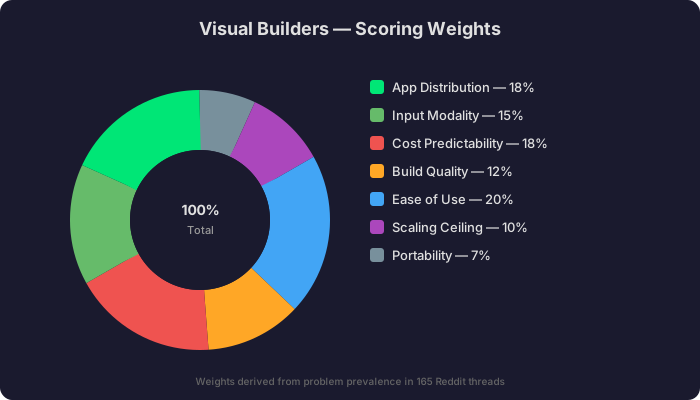
Tier 1 Rubric: Visual Builders for Non-Developers
The following rubric is calibrated for non-technical builders — people who want to create apps without writing code. The weights reflect what matters most to this audience, derived from the problem landscape data.
| # | Dimension | Weight | Rationale |
|---|---|---|---|
| 1 | App Distribution (mobile + app stores + PWA + web reach) | 20% | Reach matters most for early app success. This report assumes that apps are launching to achieve commercial success, and key to that is marketing and user growth. App store distribution opens up over a billion devices, and includes the ability to use push notifications, one of the most trusted communication forms |
| 2 | Input Modality Flexibility (prompt + visual + hybrid) | 18% | For non-developers, how you interact with the tool IS the product. A visual builder with AI assistance vs. a prompt-only interface vs. a complex widget tree — these aren’t features, they’re fundamentally different experiences. |
| 3 | Cost Predictability & Value | 18% | The #1 problem in the dataset (37.6% of threads). Non-developers are often bootstrapped individuals or small businesses — cost surprises are existential. Weighted slightly lower than in a single-rubric approach because distribution and usability gate whether cost even matters. |
| 4 | Build Quality & Reliability | 15% | Combined AI/Prompt Quality + Platform Reliability (41.2% of threads). Critical, but for non-developers, a tool that’s reliable but can’t reach users is worse than one that’s imperfect but ships to app stores. |
| 5 | Ease of Use & Deployment | 20% | Built-in database, one-click deploy, how much infrastructure knowledge is assumed. Highest weight because for non-developers, the ability to actually complete and deploy an app without technical help is the most critical differentiator. |
| 6 | Scaling Ceiling | 10% | Important long-term, but most non-developer apps start small. Scaling is a tomorrow problem; getting the app built and distributed is today’s problem. |
| 7 | Code Ownership & Portability | 7% | Non-developers are least likely to self-host, fork code, or migrate to custom infrastructure. Lock-in matters, but it matters less when you can’t use the exported code anyway. |
Scoring scale: 1–10, where 10 = best-in-class. Scores reflect Reddit sentiment data, not marketing claims.
Tier 2 Rubric: Developer-Oriented Tools
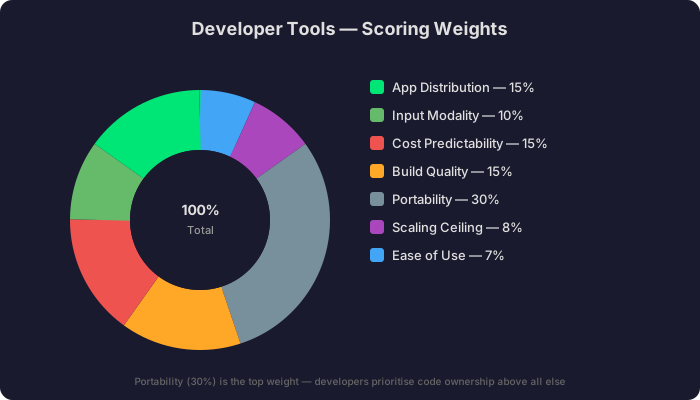
The following rubric is calibrated for developers and technical builders — people who can read and write code, manage infrastructure, and evaluate technical trade-offs. It uses the same seven dimensions as the visual builder rubric, reweighted for developer priorities: Code Ownership & Portability jumps to 30% — reflecting that developers prioritise owning and exporting their code above all else — while Input Modality and App Distribution are weighted lower since developers can adapt to any interface and have more deployment options.
| # | Dimension | Weight | Rationale |
|---|---|---|---|
| 1 | App Distribution (mobile + app stores + PWA + web reach) | 20% | Even for developers, reach matters. Publishing to app stores unlocks push notifications, discoverability, and user trust — distribution is still a competitive advantage. |
| 2 | Input Modality Flexibility (prompt + visual + hybrid) | 18% | Developers are comfortable with any interface, but multi-modal tools (visual + code + prompt) compound productivity. The best tools meet developers where they are. |
| 3 | Cost Predictability & Value | 18% | Still the #1 complaint in the dataset. The mid-2025 pricing revolts at Cursor [#96][#97] and Replit [#108][#112] show developers will switch tools over pricing. |
| 4 | Build Quality & Reliability | 15% | Combined AI/Prompt Quality + Platform Reliability. Hallucinations, error loops, and unreliable builds waste developer time — but weighted equally with the visual tier since quality matters to everyone. |
| 5 | Code Ownership & Portability | 30% | Developers care deeply about owning their code, avoiding lock-in, and deploying anywhere. The highest weight in this tier reflects that portability is the defining professional concern — it determines long-term viability of any tool investment. |
| 6 | Scaling Ceiling | 8% | Important long-term for production apps. Architectural ceilings and performance degradation are professional deal-breakers. |
| 7 | Ease of Use & Deployment | 7% | Developers expect steeper learning curves and can manage deployment pipelines. Swapped down from the visual tier’s 12% — ease of use is less of a differentiator for technical users. |
4. Platform Scorecards
Tier 1 — Visual Builders for Non-Developers
Adalo
| Dimension | Score | Weight | Weighted | Evidence |
|---|---|---|---|---|
| App Distribution | 7 | 15% | 1.05 | Native mobile output (React Native); direct app store publishing; the core use case. No other visual no-code builder matches this combination [#15][#24][#39]. |
| Input Modality Flexibility | 7 | 15% | 1.05 | Multi-screen canvas with direct component manipulation; PowerPoint-style drag-and-drop; “most straightforward by far” [#160]; AI features in development [#31]. Easiest learning curve in the dataset. |
| Cost Predictability & Value | 5 | 20% | 1.00 | Straightforward plan structure; but pricing concerns [#34][#35]; free plan data deletion during 3.0 migration [#35]. |
| Build Quality & Reliability | 3 | 12% | 0.36 | “Pages with missing elements, load times are atrocious” [#31]; widely perceived as declining [#31]. The acknowledged weakness. However, Adalo 3.0 (Sep 2025) delivered 40–70% CPU reductions; forum users confirmed: “the app is going considerably faster” [F-3], and a maker serving tens of thousands said “Adalo apps now perform really really well” [F-4]. |
| Ease of Use & Deployment | 8 | 20% | 1.60 | Built-in database; built-in hosting; one of the simplest paths from concept to deployed mobile app. Multi-screen canvas is genuinely intuitive for non-developers. |
| Scaling Ceiling | 2 | 10% | 0.20 | “Hugely inefficient frontend…unbearable slowness” [#32]; most negative scaling data in dataset. Adalo 3.0’s infrastructure overhaul addressed this with quadruple redundancy, database indexing, and React Native upgrades; early forum feedback confirmed measurable improvements [F-2][F-3]. |
| Code Ownership & Portability | 3 | 7% | 0.21 | Limited export; React Native base theoretically exportable [#33]; but no clean path. |
Weighted Total: 5.58
Summary: Adalo’s core proposition of the easiest and fastest path from zero to published web app, Android and iOS app in the app stores remains differentiated. No other visual no-code builder matches its combination of beginner accessibility, a visual canvas displaying the entire app at once, built-in database, and native mobile output. The multi-screen canvas with PowerPoint-style drag-and-drop is often cited as the most intuitive design experience for someone who has never built an app. But the performance data is concerning [#32], and migration flows in early 2025 overwhelmingly trend outward [#31][#34][#36]. The 3.0 relaunch in late 2025 with an overhauled backend for performance and scale drew user appreciation. AI features have been rolled out, and the AI builder is being released to beta testers. This points to the company’s new management addressing its negative points, specifically calling out that Adalo is no longer ‘MVP software’.
Adalo has also announced capabilities for SMB and enterprise, citing a partnership with DreamFactory as allowing the integration of any system into an Adalo App, even if it has no API. Sheetbridge was also recently announced, which allows an Adalo user to turn a Google Sheet into a database, building their app atop the spreadsheet much like Glide or Softr makers do.
Glide
| Dimension | Score | Weight | Weighted | Evidence |
|---|---|---|---|---|
| App Distribution | 3 | 15% | 0.45 | PWA-based; not native; limited store presence. Web apps and mobile-responsive, but no app store path. |
| Input Modality Flexibility | 6 | 15% | 0.90 | Visual builder; spreadsheet-driven data model; no prompt-based input; quick for simple apps [#163]. |
| Cost Predictability & Value | 4 | 8% | 0.32 | Per-user pricing limits entrepreneurial use [#28][#30]; enterprise-focused. |
| Build Quality & Reliability | 7 | 15% | 1.05 | “Runs really fast, even with a lot of data” [#29]; “logical once you figure it out” [#29]; limited complaint data. |
| Ease of Use & Deployment | 8 | 20% | 1.60 | Built-in everything; spreadsheet as database; simplest data model setup. |
| Scaling Ceiling | 5 | 10% | 0.50 | Good for internal tools; per-user pricing creates scaling cliff for external apps [#30]. |
| Code Ownership & Portability | 2 | 7% | 0.14 | No code export; spreadsheet-backed. |
Weighted Total: 5.24
Summary: Excellent for internal business tools and simple mobile-first apps. The spreadsheet data model is both its greatest strength (simplicity) and greatest limitation (scaling). Glide’s build quality is the best in Tier 1, but the lack of app store publishing and per-user pricing limit its reach for consumer-facing apps. Data gap: only 6 threads; internal enterprise use likely underrepresented on Reddit.
Lovable
| Dimension | Score | Weight | Weighted | Evidence |
|---|---|---|---|---|
| App Distribution | 2 | 18% | 0.36 | “You can do only web apps” [#50]; no React Native [#56]; PWA wrapper only path. A hard ceiling for mobile-first builders. |
| Input Modality Flexibility | 5 | 20% | 1.00 | Strong prompt interface; weak manual tooling for iteration [#42][#49]; “stop using Lovable for everything” [#42]. Good for initial generation, frustrating for refinement. |
| Cost Predictability & Value | 4 | 8% | 0.32 | Credit burn on bug-fixing [#46]; 400 credits/hour reported [#46]; “Never worried about what a change would cost” [#41]. |
| Build Quality & Reliability | 5 | 20% | 1.00 | Clean initial output [#47][#55]; cascading bugs during iteration [#43][#49]; AI-initiated migrations [#43]. |
| Ease of Use & Deployment | 7 | 15% | 1.05 | Supabase + Vercel integrated; Lovable Cloud had breakage issues [#57]. |
| Scaling Ceiling | 5 | 10% | 0.50 | Web-focused; Supabase backend handles scale; front-end complexity limited [#42]. |
| Code Ownership & Portability | 8 | 7% | 0.56 | React + Supabase; senior engineers called output “very clean” [#47]; Git integration. |
Weighted Total: 4.89
Summary: Polarising. Loved for prototyping speed and code quality; hated for credit economics and production reliability. The “first 80%” tool — consistently recommended as a starting point to be finished in Cursor or Claude Code [#42][#53]. The lack of native mobile output is a hard ceiling for a significant segment of builders. Among Tier 1 platforms, Lovable’s strongest asset (code portability) carries the least weight for non-developers — who are unlikely to finish their app in a code editor.
Base44
| Dimension | Score | Weight | Weighted | Evidence |
|---|---|---|---|---|
| App Distribution | 2 | 18% | 0.36 | “Don’t believe it creates mobile native apps yet” [#62]; working on it [#65]. Web only for now. |
| Input Modality Flexibility | 7 | 15% | 1.05 | “Best natural-language builder chat…deeply app focused, brilliant” [#64]; strongest prompt interface for non-coders. |
| Cost Predictability & Value | 5 | 20% | 1.00 | Competitive pricing; but credit burn on reverts [#59]; $939 total spend documented [#59]. |
| Build Quality & Reliability | 3 | 12% | 0.36 | “Smallest tweaks cause catastrophic reverts” [#59]; “once you bring in multiple APIs…everything breaks” [#63]. |
| Ease of Use & Deployment | 8 | 20% | 1.60 | Built-in database, built-in hosting; simplest deployment of any platform in dataset. |
| Scaling Ceiling | 2 | 10% | 0.20 | “Designed for a maximum of about 100 users” [#61]; not production-grade. |
| Code Ownership & Portability | 3 | 7% | 0.21 | Front-end exportable; “does not allow you to take your backend to Git” [#64]. |
Weighted Total: 4.68
Summary: The most accessible AI builder for non-technical users, with the strongest natural-language interface in the dataset. But the ~100 user ceiling, backend lock-in, and catastrophic revert behaviour make it unsuitable for anything beyond prototypes and very small-scale apps. The Wix acquisition ($80M, July 2025) signals investment but hasn’t yet resolved fundamental limitations. Data gap: only 7 threads; very new platform.
Bubble
| Dimension | Score | Weight | Weighted | Evidence |
|---|---|---|---|---|
| App Distribution | 3 | 15% | 0.45 | Web-first; native mobile via wrappers only; limited store presence. |
| Input Modality Flexibility | 7 | 15% | 1.05 | Most flexible visual no-code builder [#15][#161]; steep learning curve [#8]; no prompt-based building. |
| Cost Predictability & Value | 3 | 15% | 0.45 | WU model makes scaling arithmetic terrifying [#1][#2][#16]; unpredictable consumption. |
| Build Quality & Reliability | 4 | 30% | 1.20 | Chronic outages [#5][#6][#7]; editor memory leaks [#4]; “Bubble’s reliability is currently out of control” [#7]. |
| Ease of Use & Deployment | 7 | 15% | 1.05 | Built-in database, built-in hosting, one-click deploy; highest all-in-one completeness of traditional no-code. But steep learning curve offsets ease. |
| Scaling Ceiling | 4 | 8% | 0.32 | WU costs make growth unsustainable before architectural limits; “400-500 WU per user per day” [#2]. |
| Code Ownership & Portability | 1 | 7% | 0.07 | No code export whatsoever [#9][#11]; “stuck paying them forever”. |
Weighted Total: 4.48
Summary: The incumbent with the most data (25 threads) and the most negative sentiment (net: -60). Still the most flexible no-code builder for complex web apps, but the WU pricing model, complete vendor lock-in, and reliability issues create a compounding trust deficit. Migration narratives consistently flow away from Bubble [#1][#3][#14]. For non-developers, Bubble’s flexibility is offset by its steep learning curve — you need significant time investment to unlock that flexibility, and the pricing model punishes you once you do.
Appy Pie
| Dimension | Score | Weight | Weighted | Evidence |
|---|---|---|---|---|
| App Distribution | 4 | 8% | 0.32 | Claims to support app store publishing; template-based approach; quality questioned [#131]. |
| Input Modality Flexibility | 3 | 15% | 0.45 | Template-based; limited customisation; “don’t try to make any custom app” [#131]. |
| Cost Predictability & Value | 2 | 18% | 0.36 | Fraudulent billing accusations [#130]; “unscrupulous company” [#130]. |
| Build Quality & Reliability | 1 | 12% | 0.12 | Scam accusations across multiple threads [#130][#131][#132]; “absolute garbage” [#130]. |
| Ease of Use & Deployment | 5 | 20% | 1.00 | Template + publish flow is simple in theory; quality of output is the issue. |
| Scaling Ceiling | 2 | 10% | 0.20 | No data suggesting production viability. |
| Code Ownership & Portability | 1 | 7% | 0.07 | No export capability documented. |
Weighted Total: 2.92
Summary: The lowest-rated platform in our dataset by a significant margin. Reddit sentiment is overwhelmingly negative, with fraud and scam accusations appearing across multiple subreddits over multiple years. The Automate (workflow) product has defenders [#134], but the app builder has essentially none. Data gap: 5 threads, mostly older. We flag the possibility that Appy Pie’s current product may differ from these historical reviews — but the consistency of complaints across years is concerning.
Visual Builder Ranking Table
| Rank | Platform | App Dist (18%) | Input Flex (15%) | Cost (18%) | Quality (12%) | Ease (20%) | Scale (10%) | Portability (7%) | Weighted Total |
|---|---|---|---|---|---|---|---|---|---|
| 1 | Adalo | 7 | 7 | 5 | 3 | 8 | 2 | 3 | 5.58 |
| 2 | Glide | 3 | 6 | 4 | 7 | 8 | 5 | 2 | 5.24 |
| 3 | Lovable | 2 | 5 | 4 | 5 | 7 | 5 | 8 | 4.89 |
| 4 | Base44 | 2 | 7 | 5 | 3 | 8 | 2 | 3 | 4.68 |
| 5 | Bubble | 3 | 7 | 3 | 4 | 7 | 4 | 1 | 4.48 |
| 6 | Appy Pie | 4 | 3 | 2 | 1 | 5 | 2 | 1 | 2.92 |
Key observations:
Adalo leads on the dimensions that matter most to non-developers. Its 7/7/8 scores on App Distribution, Input Flexibility, and Ease of Use are the strongest triple in the tier. The multi-screen canvas with built-in database and native mobile output is a genuinely differentiated combination. Build Quality (3) and Scaling (2) are the acknowledged weaknesses — the 3.0 launch needs to address them.
Glide is the quality leader but distribution-limited. The highest Build Quality score (7) in the tier, but PWA-only distribution and per-user pricing cap its reach.
Lovable’s strengths are misaligned with its audience. Its best score (Code Portability: 8) carries the least weight for non-developers. Its worst scores (App Distribution: 2) carry the most weight.
Bubble’s flexibility premium has eroded. At 4.48, the most-discussed platform in the dataset ranks 5th among visual builders. The steep learning curve, WU pricing, and zero code export compound into a poor value proposition for non-developers.
Appy Pie is not a serious platform. The data is unambiguous.
Tier 2 — Developer-Oriented Tools
Claude Code
| Dimension | Score | Weight | Weighted | Evidence |
|---|---|---|---|---|
| App Distribution | 7 | 15% | 1.05 | Can generate Swift/Kotlin directly [#87]; requires dev knowledge for Xcode/signing. |
| Input Modality Flexibility | 4 | 8% | 0.32 | Prompt-only; no visual design tooling; requires coding literacy to use effectively [#147]. |
| Cost Predictability & Value | 7 | 15% | 1.05 | $200/mo plan widely praised as excellent value [#89]; lower tiers opaque [#80][#88]. |
| Build Quality & Reliability | 8 | 15% | 1.20 | “Results are so far ahead of the others” [#85]; context loss is real but manageable [#90]. Best coding agent quality in the dataset. |
| Code Ownership & Portability | 10 | 30% | 3.00 | Produces standard code you own entirely. No lock-in whatsoever. |
| Scaling Ceiling | 6 | 8% | 0.48 | Breaks down at project scale [#92]; requires discipline (600-line file limits). |
| Ease of Use & Deployment | 3 | 7% | 0.21 | “Built my app in 20 minutes. Spent 3 weeks deploying” [#83]; assumes infrastructure knowledge. |
Weighted Total: 7.39
Summary: The most capable code generation tool in the dataset, with the strongest positive sentiment trajectory of any platform (net sentiment: +16). Mass migration from Cursor validates quality — a pattern confirmed on X, where @levelsio observed “In July, everyone switched from Cursor to Claude Code” [X-12], @henrythe9ths noted “it’s getting harder to justify the $20/month Cursor subscription…One founder told me his team saved 27 hours weekly after switching to Claude Code” [X-11], and @ZacharyHuang12 explained the technical reasoning: “Cursor apparently can’t afford it. Claude Code nails both [agent design and token usage]” [X-9]. Dan Shipper called it “one of the best AI-first coding experiences” [X-20], and Vercel’s @leerob praised “the power of extremely fast loops with agents” [X-21]. The $200/month plan’s value proposition ($625–$2,678 in API credit equivalent [#89]) is accelerating adoption. Best for technical founders and developers who want AI acceleration, not AI replacement.
Cursor
| Dimension | Score | Weight | Weighted | Evidence |
|---|---|---|---|---|
| App Distribution | 6 | 15% | 0.90 | Can generate any code; requires developer deployment knowledge. Slightly lower than Claude Code due to less native mobile evidence. |
| Input Modality Flexibility | 5 | 20% | 1.00 | Prompt + inline editing in VS Code; multi-model selection [#119]; familiar UX for VS Code users. The IDE-native experience gives developers a comfortable, productive workflow. |
| Cost Predictability & Value | 4 | 8% | 0.32 | July 2025 pricing changes triggered community-wide revolt and forced refunds [#96][#97]; “insanely expensive” [#98]; mass exodus to Claude Code. |
| Build Quality & Reliability | 7 | 15% | 1.05 | Good autocomplete (Tab feature) [#98]; but hallucinations [#94][#95][#99]; “Cursor is getting worse and worse” [#95]. Quality declining over time. |
| Code Ownership & Portability | 10 | 30% | 3.00 | VS Code fork; produces standard code you own entirely. |
| Scaling Ceiling | 6 | 8% | 0.48 | Standard code output; no inherent scaling ceiling. Context degradation on large projects similar to Claude Code. |
| Ease of Use & Deployment | 3 | 7% | 0.21 | Same deployment assumptions as Claude Code. No built-in hosting. |
Weighted Total: 6.74 (estimate — Cursor was not in the original scorecard; scores derived from research bank evidence)
Summary: A capable AI coding tool suffering from self-inflicted wounds. The July 2025 pricing backlash triggered the dominant migration pattern in our dataset: Cursor → Claude Code (10+ threads [#84][#91][#96][#97][#98][#101][#102][#103]). An entire 15-person startup switched [#91]. On X, one detailed cost analysis found that one user spent "$2,500 in token costs over 5 months" with Cursor before diversifying to Claude Code [X-9], and @mitsuhiko calculated that “the $100 plan of Claude Code is a better deal than the $200 plan of Cursor” [X-13]. The “Cursor Is Dying” narrative [#100] (February 2026) reflects real sentiment decline. Build quality remains solid but is perceived as degrading, and the pricing revolt has permanently damaged trust.
FlutterFlow
| Dimension | Score | Weight | Weighted | Evidence |
|---|---|---|---|---|
| App Distribution | 7 | 15% | 1.05 | Strong app store publishing via native Flutter output [#24]; but fragile build pipeline with iOS-breaking updates [#23] tempers the score. Publishing capability is there, but reliability is a concern. |
| Input Modality Flexibility | 6 | 15% | 0.90 | Strong visual builder; DreamFlow AI addition; debugging visibility praised [#49]; steep learning curve [#26]. |
| Cost Predictability & Value | 4 | 8% | 0.32 | Pricing doubled mid-2025 [#20][#149]; DreamFlow diverting resources [#18]. |
| Build Quality & Reliability | 5 | 20% | 1.00 | FF 6.0 regressions [#21][#22]; iOS-breaking updates [#23]; “widgets wrapped in more widgets” [#19]. |
| Code Ownership & Portability | 5 | 20% | 1.00 | Flutter code export is a differentiator [#15][#152]; but you’re locked to Flutter/Dart — not any language or framework you want. Partial portability, not full. |
| Scaling Ceiling | 6 | 8% | 0.48 | Flutter compilation = native performance; code export enables escape hatch. |
| Ease of Use & Deployment | 6 | 7% | 0.42 | Firebase integration; requires some Flutter knowledge for custom code; not fully turnkey. |
Weighted Total: 5.40
Summary: The strongest visual-first platform for mobile app publishing, thanks to Flutter code export and native compilation. In the developer tier, FlutterFlow occupies a unique niche: visual building that produces real, deployable code. But mid-2025 pricing changes eroded trust, FF 6.0 regressions damaged reliability, and the DreamFlow pivot created concern about platform focus. For developers who want visual prototyping with a code escape hatch, it remains a strong option — provided they can tolerate the instability.
Retool
| Dimension | Score | Weight | Weighted | Evidence |
|---|---|---|---|---|
| App Distribution | 1 | 15% | 0.15 | Internal tool platform; not designed for app store publishing. |
| Input Modality Flexibility | 5 | 20% | 1.00 | Visual builder + code extensibility; “incredibly flexible — you can build anything” [#125]; but “time-sucking drudgery” for UI [#121]. |
| Cost Predictability & Value | 4 | 8% | 0.32 | “5 digits annually” for enterprise [#122]; sneaky cost escalation [#123]; free after 500 external users is notable [#125]. |
| Build Quality & Reliability | 6 | 15% | 0.90 | Backend flexibility praised [#121]; GUI builder frustrating [#126]; “moving components randomly broke data connections” [#126]. |
| Code Ownership & Portability | 4 | 30% | 1.20 | Some code extensibility; not fully exportable; alternatives like Appsmith offer open-source path [#127]. |
| Scaling Ceiling | 7 | 8% | 0.56 | Designed for enterprise use; handles data at scale; cost is the scaling concern, not architecture. |
| Ease of Use & Deployment | 6 | 7% | 0.42 | Built-in data connectors; database integrations; requires some technical knowledge; self-hosted option. |
Weighted Total: 4.33
Summary: A strong platform for internal tools and admin panels, poorly suited for consumer-facing apps. The pricing model makes it expensive at enterprise scale, and the GUI builder frustrates developers who’d rather write code. Alternatives like Appsmith and Budibase offer open-source paths for budget-conscious teams [#127]. Not directly comparable to consumer app builders — included for completeness within the developer tier.
Replit
| Dimension | Score | Weight | Weighted | Evidence |
|---|---|---|---|---|
| App Distribution | 4 | 8% | 0.32 | Native mobile support added December 2025 [#115]; built-in web hosting. |
| Input Modality Flexibility | 5 | 20% | 1.00 | Prompt-based with integrated preview; decent for initial generation; poor for iteration. |
| Cost Predictability & Value | 3 | 15% | 0.45 | “A weaker, limited model makes more mistakes = more billable agent runs” [#108]; $400+ on simple projects [#106]; "$500 in agent 3 in a week" [#113]. |
| Build Quality & Reliability | 3 | 12% | 0.36 | Agent “isn’t ‘debugging’ your app. It’s staging an illusion” [#107]; CEO apologised after agent wiped codebase [#111]; “DONT DO ANY PROJECTS REMOTELY CHALLENGING” [#106]. |
| Code Ownership & Portability | 6 | 30% | 1.80 | Code is accessible and downloadable; but platform-dependent deployment encourages lock-in. |
| Scaling Ceiling | 4 | 8% | 0.32 | Complex projects fail [#106]; quality degrades with scale; simple web apps only. |
| Ease of Use & Deployment | 7 | 7% | 0.49 | Best-in-class deployment ease: integrated hosting, one-click deploy, zero infrastructure needed. |
Weighted Total: 4.61 (estimate — Replit was not in the original scorecard; scores derived from research bank evidence)
Summary: The worst sentiment of any developer tool in the dataset (net: -67). The exploitative pricing model [#108], agent-faking behaviour [#107], and codebase-wiping incident [#111] have created deep trust issues. The “Replit might not survive 2026” narrative [#105] reflects community consensus. The December 2025 native mobile launch [#115] is a positive signal, but it comes too late to offset the accumulated damage. Ease of deployment (7) is its genuine strength — no other tool makes going from idea to live app as frictionless — but that ease comes at the cost of reliability and quality.
Developer Tool Ranking Table
| Rank | Platform | App Dist (15%) | Input Flex (10%) | Cost (15%) | Quality (15%) | Portability (30%) | Scale (8%) | Ease of Use (7%) | Weighted Total |
|---|---|---|---|---|---|---|---|---|---|
| 1 | Claude Code | 7 | 4 | 7 | 8 | 10 | 6 | 3 | 7.39 |
| 2 | Cursor | 6 | 5 | 4 | 7 | 10 | 6 | 3 | 6.74 |
| 3 | FlutterFlow | 7 | 6 | 4 | 5 | 5 | 6 | 6 | 5.40 |
| 4 | Replit | 4 | 5 | 3 | 3 | 6 | 4 | 7 | 4.61 |
| 5 | Retool | 1 | 5 | 4 | 6 | 4 | 7 | 6 | 4.33 |
Key observations:
Claude Code dominates the developer tier. Best quality (8), perfect portability (10), and strong cost value at $200/month create a wide lead. The gap between Claude Code (7.39) and second-place Cursor (6.74) is the largest between any two adjacent platforms in either tier.
Cursor holds second despite its pricing revolt. Perfect portability (10), solid build quality (7), and a familiar VS Code-based workflow keep it ahead of FlutterFlow. But the July 2025 pricing backlash triggered the dominant migration pattern in the dataset: Cursor → Claude Code (10+ threads). The mass exodus has permanently damaged trust.
FlutterFlow is the only visual tool in the developer tier. Its App Distribution score (7) rewards genuine app store publishing capability, but partial portability (5 — Flutter-only, not any language) and lower build quality (5) keep it behind the pure coding tools. For developers who want visual prototyping with a code escape hatch, it’s a viable option.
Replit edges ahead of Retool but remains in crisis. Lowest Build Quality (3), lowest Cost value (3), and the worst community sentiment of any platform in the full dataset. Replit’s high Portability score (6) benefits significantly from the 30% weight, pushing it to 4.61 — slightly ahead of Retool (4.33).
Retool serves a different market. Internal tools ≠ consumer apps. Its Scaling Ceiling (7) is the highest in the tier, but App Distribution (1) is devastating under 15% weighting.
Cross-Tier Observations
The market has bifurcated — and many builders are in the wrong tier.
The most important finding of this analysis isn’t any individual platform ranking. It’s that the app building market has split into two fundamentally different categories, and platforms marketed as “no-code” often require significant technical knowledge. FlutterFlow’s reclassification is the clearest example, but the pattern is broader:
Vibe coding tools (Lovable, Base44) are visual builders marketed to non-developers, but their output often requires developer skills to finish. Lovable is consistently recommended as a “starting point” to be finished in Cursor or Claude Code [#42][#53]. Base44’s ~100 user ceiling means any serious app needs developer intervention.
The “no-code” label has become meaningless. Platforms ranging from Appy Pie (template-based, genuinely no-code) to FlutterFlow (widget-tree editor requiring Firebase/Supabase configuration) all claim the same label. The split forces clarity. On X, the sentiment is crystallising: Philip Daineka argued that “no-code/low-code tools are becoming obsolete with the rise of AI software engineers” citing “vendor lock-in, meaning no true ownership of your app’s IP” [X-18], while @johnrushx framed it as “AI Coding is the new No-Code!…But complex apps still need real coders” [X-19].
App Distribution is the great divider. Among visual builders, native mobile output separates platforms that can reach users from platforms that can’t. Adalo (7), Appy Pie (4), Bubble (3), Glide (3), Base44 (2), and Lovable (2) — only Adalo provides genuine app store publishing for non-developers.
Code Ownership matters inversely to technical skill. Developers weight portability highly (20%) because they can use exported code. Non-developers weight it lowest (7%) because they can’t. This explains why Lovable scores well among developers but poorly for its actual target audience — its best feature (clean React export) is useless to the people it’s marketed to.
5. Forward Look
The vibe coding disillusionment curve
The Reddit data maps a textbook hype cycle for AI-assisted building. Early 2025: excitement and experimentation. Mid-2025: the first reverse migrations [#136]. Late 2025: the backlash peaks with high-engagement threads on maintenance debt [#135][#137][#138].
By February 2026, a consensus has crystallised: vibe coding is a “Tier-2 tool” [#147] — powerful when wielded by someone who understands code, dangerous when used as a code replacement by someone who doesn’t.
The implication: platforms that combine AI acceleration with structured, visual building — not pure prompt interfaces — may emerge as the pragmatic middle ground.
The pricing revolt reshapes the market
The simultaneous mid-2025 pricing changes at Cursor, FlutterFlow, v0, and Replit didn’t just generate complaints. They generated migration. Cursor → Claude Code was the dominant migration pattern in our dataset (10+ threads [#84][#91][#96][#97][#98][#101][#102][#103]). An entire 15-person startup switched [#91].
The lesson: builders will tolerate high prices for quality, but not unpredictable prices or sudden changes. Platforms that can offer transparent, predictable pricing have a structural advantage.
AI maintenance is the next crisis
25 threads flagged post-vibe-coding maintenance problems [#135–#143]. AI generates code quickly but creates technical debt that’s invisible until it compounds. Security vulnerabilities (public S3 buckets [#140]), code duplication [#142], and unmaintainable architecture [#139] are emerging as real-world consequences. On X, @johanstn warned of “technical debt at scale — systems that work initially but become increasingly difficult to maintain or modify over time” [X-6], and developer Sam Noble observed junior devs “ship features they can’t maintain” and “debug by prompting AI instead of understanding the problem” [X-23]. Multiple startups have reported what Simon Kim called “AI debt problems — the complexity of AI-generated code increasing” since H2 2025 [X-24].
The platforms that solve this — through structured code generation, visual debugging, or hybrid AI+manual approaches — will define the next wave.
Mobile-native remains underserved
Among AI builders, mobile app store publishing is essentially unsolved. Lovable is web-only [#50]. Bolt has no deployment pipeline [#72]. Base44 can’t create native apps [#62]. Replit only added mobile support in December 2025 [#115]. Claude Code can generate native code but requires developer expertise [#87].
Among visual builders for non-developers, only Adalo provides genuine native mobile output with app store publishing — and its performance problems [#32] are well-documented. This gap is enormous and largely unaddressed by the AI builder wave.
The visual builder tier has a clear leader — with caveats
Among genuine visual builders for non-developers, Adalo leads on the dimensions that matter most to this audience: App Distribution (7), Input Flexibility (7), and Ease of Use (8). No other platform in Tier 1 matches this combination.
But leadership comes with asterisks. Adalo’s Build Quality (3) and Scaling Ceiling (2) are the worst in the tier after Appy Pie. The 3.0 relaunch and promised AI builder features [#31] are the key variables. If performance improves and the AI builder delivers on non-developer accessibility, Adalo’s positioning is genuinely underserved by competitors. If they don’t, the migration pattern that has characterised the platform for three years will continue.
Where the puck is heading
The data suggests app building is bifurcating along the lines this report formalises:
For technical builders: Claude Code is the dominant tool, displacing Cursor and AI builders. The $200/month plan’s value proposition is accelerating this. The 0.65-point gap over second-place Cursor (7.39 vs 6.74) reflects its broad strength across dimensions.
For non-technical builders who need mobile apps: The market has a hole. Adalo leads (5.58) but must prove its 3.0 performance improvements and AI builder. No other visual platform provides genuine app store publishing for non-developers.
For internal tools: Retool dominates but open-source alternatives (Appsmith, Budibase, ToolJet) are gaining. The category is separate from consumer app building.
For prototypes/MVPs: Lovable + Claude Code as a two-step workflow is becoming the standard recommendation [#42][#53][#78] — but this is inherently a developer workflow, not a non-developer one.
Methodology Appendix
Data Collection
- Time period: February 2025 – February 2026 (select earlier threads included for historical context)
- Total unique threads: 165 (deduplicated across 4 research files by URL)
- Full-text fetched: ~60 threads via Reddit JSON API
- Subreddits searched (36): r/nocode, r/Bubbleio, r/FlutterFlow, r/FlutterDev, r/glideapps, r/AppSheet, r/Adalo, r/lovable, r/Base44, r/AIToolTesting, r/boltnewbuilders, r/vibecoding, r/vercel, r/ClaudeCode, r/ClaudeAI, r/cursor, r/CursorAI, r/OpenAI, r/singularity, r/replit, r/Futurology, r/SaaS, r/Retool, r/selfhosted, r/webdev, r/startups, r/cscareerquestions, r/EnterpriseArchitect, r/Scams, r/appypie, r/n8n, r/sharepoint, r/AI_Agents, r/aipromptprogramming, r/reactjs, r/programming, r/LLMDevs, r/CodexAutomation
Search Methodology
Five search term categories:
- Platform-specific: “[Platform] problems”, “[Platform] pricing”, “[Platform] review”, “[Platform] vs [Platform]”
- Problem-specific: “no-code scaling”, “vendor lock-in”, “code export”, “app store publishing no-code”
- Comparison: “vibe coding vs no-code”, “Bubble vs FlutterFlow”, “Lovable vs Bolt vs Cursor”
- Migration: “leaving [Platform]”, “migrated from [Platform]”
- Meta: “no-code dead”, “vibe coding problems”, “AI coding maintenance”
Categorisation
Each thread was categorised by:
- Primary platform(s) discussed
- Problem category (multi-tag allowed)
- Sentiment (Strongly Negative / Negative / Mixed / Positive / Strongly Positive / Neutral)
- Special flags: [PRICING_TCO], [NOCODE_VS_AI], [APP_STORE], [POST_VIBE_PROBLEMS], [ENTERPRISE]
Exclusions
- Threads with 0 comments and 0 upvotes excluded from full fetch
- Removed/deleted posts included only when search snippets preserved content
- 3 cross-file duplicates removed; 1 internal duplicate removed
- Thread #30 (Glide scalability) is an aggregation without individual URLs — counted as 1 entry
Known Biases
- Negativity bias: Reddit threads skew toward complaints. Satisfied users rarely post “everything works fine.”
- Platform representation bias: Platforms with larger Reddit communities (Bubble, Cursor, Lovable) have more data. Platforms with smaller communities (Appy Pie, Base44, Glide) have thinner samples.
- Recency bias: AI builders (Lovable, Base44, Bolt) have shorter histories, making trend analysis less reliable.
- Audience bias: Reddit’s developer-heavy audience may underweight truly non-technical user experiences.
- Potential astroturfing: Newer platform subreddits (r/Base44) may contain promotional posts not fully filtered.
Endnote Reference List
Pricing & Cost
- [#1] Is Bubble’s pricing model making no-code unsustainable? — r/nocode, 2024-12-06
- [#2] Bubble workload units makes scaling impossibly expensive — r/Bubbleio, 2025-01-25
- [#3] Leaving Bubble.io after building an MVP for 1.5 year — r/nocode, 2025-06-06
- [#16] Bubble.io’s game-changing pricing: goodbye capacity — r/nocode, 2023-04-06
- [#20] What are your thoughts on the new FlutterFlow pricing? — r/FlutterFlow, 2025-06-04
- [#28] Glide App to AppSheet — r/AppSheet, 2024-08-31
- [#30] Glide scalability — per-user pricing limits entrepreneurial use — aggregated Glide threads, 2024–2025
- [#34] Leaving Adalo: Where to move Apps? — r/Adalo, 2023-02-23
- [#35] Adalo Free Plan Users: Important Update — r/Adalo, 2024-11-26
- [#41] The Problem with Lovable — r/lovable, 2025-06-18
- [#45] Disappointed Experience — r/lovable, 2025-08-22
- [#46] Lovable credit system is killing me — r/lovable, 2025-08-12
- [#48] Disappointed by Lovable 2.0 — r/nocode, 2025-07-21
- [#59] Is Base44 a good AI App builder? — r/Base44, 2025-10-09
- [#61] A month with Base44 = unusable app + wasted credits — r/Base44, 2025-11-23
- [#64] Brutal Review of All No Code Platforms — r/vibecoding, 2025-11-03
- [#65] Why Base44 is so good — r/Base44, 2025-12-20
- [#66] Why I no longer recommend bolt.new — r/boltnewbuilders, 2025-03-07
- [#67] Bolt V2 disappointing — r/boltnewbuilders, 2025-10-01
- [#69] bolt.new breaking down after a certain point — r/boltnewbuilders, 2025-03-25
- [#75] Vercel dropped the ball with v0.dev pricing — r/vercel, 2025-05-14
- [#80] Claude usage consumption unreasonable — r/ClaudeCode, 2026-01-04
- [#84] Burning money on Cursor, switched to Claude Code — r/ClaudeCode, 2026-02-12
- [#88] Usage Limits Megathread — r/ClaudeAI, 2025-12-29
- [#89] Claude Code $200 Plan Math — r/ClaudeAI, 2025-12-18
- [#96] Cursor’s new pricing — biggest AI disappointment — r/cursor, 2025-07-04
- [#97] Cursor pricing backlash — forced refunds — r/singularity, 2025-07-05
- [#98] Cursor insanely expensive — r/cursor, 2026-01
- [#101] Cursor Ultra $200 — Claude Opus burned through my credits — r/cursor, 2026-01
- [#102] Any Cursor alternatives to suggest? — r/cursor, 2025-07-07
- [#103] Cursor’s downfall — r/cursor, 2025-07-04
- [#105] Replit might not survive 2026 — r/replit, 2026-01-07
- [#106] Replit Review — simple projects only — r/replit, 2025-05-23
- [#108] Replit mistakes are the business model — r/replit, 2025-06-27
- [#110] Replit way too expensive — r/replit, 2025-07-03
- [#112] Replit pricing model change — r/replit, 2025-07-15
- [#113] Agent 3 burning hundreds — r/replit, 2025-10-09
- [#117] Claude Code vs Cursor vs Copilot pricing — r/CodexAutomation, 2025-09-01
- [#122] Retool Enterprise Costs — r/Retool, 2025-01-23
- [#123] Who worked with Retool? — r/SaaS, 2024-04-28
- [#124] Is Retool okay for user-facing apps? — r/nocode, 2024-03-04
- [#130] Appy Pie is absolute garbage — r/nocode, 2021-02-10
- [#137] The dark reality behind AI Vibe Coding — r/vibecoding, 2025-07-23
- [#149] FlutterFlow pricing plans are bad — r/FlutterFlow, 2025-06-24
- [#151] What is wrong with vendor lock-in? — r/nocode, 2024-10-12
AI/Prompt Quality
- [#53] Are Bolt/Lovable/v0 better than Claude Code? — r/vibecoding, 2025-07-25
- [#58] Getting frustrated with Lovable — r/lovable, 2025-03-16
- [#68] Anyone else think Bolt sucks? — r/boltnewbuilders, 2025-05-11
- [#74] Why I regret subscribing to v0.dev — r/vercel, 2025-04-30
- [#81] Frustrated with Claude Code — struggles to refine — r/ClaudeAI, 2025-06-08
- [#82] Are people actually getting bad code from Claude? — r/ClaudeAI, 2025-07-22
- [#85] Claude Code is the best coding agent — r/ClaudeAI, 2025-11-28
- [#90] Context loss is the real problem — r/ClaudeCode, 2026-02-10
- [#92] Claude Code breaks down at scale — r/vibecoding, 2025-07-20
- [#93] Frustrating experience with Cursor — r/cursor, 2025-03-30
- [#94] Honest review — don’t use Cursor — r/CursorAI, 2025-04-22
- [#95] Cursor is getting worse and worse — r/cursor, 2025-04-26
- [#99] Cursor hallucinations after 10+ rounds — r/cursor, 2025-06-05
- [#107] Replit Agent isn’t just failing — it’s faking it — r/replit, 2025-06-01
- [#111] Replit CEO apologises after agent wiped code — r/Futurology, 2025-07-26
- [#118] Is Claude Code better than Cursor? — r/ClaudeAI, 2025-06-22
- [#135] The problem with vibe coding is maintenance — r/vibecoding, 2025-10-12
- [#136] Been vibe coding 5 months, went back to no-code — r/nocode, 2025-05-08
- [#138] 2025 vibe coding, 2026 will expose weak foundations — r/vibecoding, 2025-12-31
- [#139] Just vibe coding is not sufficient for complex apps — r/vibecoding, 2025-09-19
- [#140] Vibe coding failures prove AI not replacing devs — r/webdev, 2025-09-01
- [#141] Why vibe coding makes me want to throw up — r/programming, 2025-03-17
- [#142] Vibe coding is not working and here’s why — r/vibecoding, 2025-08-02
- [#143] Current state of vibe coding — crossed a threshold — r/OpenAI, 2025-06-20
- [#147] Use no-code or learn vibe coding? — r/AI_Agents, 2025-05-27
Platform Reliability & Bugs
- [#4] Is Bubble editor getting buggier? — r/Bubbleio, 2025-07-07
- [#5] Why does Bubble go down so often? — r/Bubbleio, 2025-03-19
- [#6] Rant about Bubble uptime — r/Bubbleio, 2024-04-24
- [#7] What is going on with these outages? — r/Bubbleio, 2024-04-24
- [#18] FlutterFlow 2026 goals vs stability — r/FlutterFlow, 2025-11-30
- [#21] Problems with Test Mode — r/FlutterFlow, 2025-07-21
- [#22] Things suddenly don’t work — r/FlutterFlow, 2025-04-06
- [#23] URGENT: iOS-breaking error with FF update — r/FlutterFlow, 2025-02-28
- [#43] WARNING: Don’t use Lovable for production — r/lovable, 2025-11-21
- [#44] Lovable — unacceptable bugs & zero support — r/lovable, 2025-07-21
- [#57] Absolutely stuck — entire site broken — r/lovable, 2025-10-28
- [#100] Cursor is dying — r/OpenAI, 2026-02-12
- [#104] Why Replit is an awful platform — r/replit, 2025-01-23
- [#109] Replit is a scam — r/replit, 2024-09-14
- [#126] Sourcetool — sick of Retool’s GUI — r/selfhosted, 2025-05-14
- [#131] Appy Pie scam report — r/Scams, 2020-12-08
- [#132] Is Appy Pie a scam? — r/appypie, 2023-07-21
- [#134] Started with Appy Pie Automate, now exploring n8n — r/n8n, 2025-06-24
Scaling & Performance
- [#17] Viable alternative to Bubble? — r/nocode, 2025-07-09
- [#27] Building on Glide might’ve been a mistake — r/nocode, 2024-06-29
- [#31] Do people still build with Adalo? — r/nocode, 2025-01-14
- [#32] Performance analysis of Adalo app — r/nocode, 2023-05-24
- [#63] Base44 review — breaks with real data — r/AIToolTesting, 2025-07-30
- [#125] Retool for production use cases — r/Retool, 2025-01-14
- [#127] Appsmith vs Retool vs Budibase — r/selfhosted, 2022-11-15
- [#154] How can we fix no-code’s biggest problems? — r/nocode, 2024-08-01
- [#155] How fast will you hit limitations of no-code? — r/startups, 2023-09-26
- [#165] Best low/no-code tool for sophisticated enterprise apps — r/EnterpriseArchitect, 2024-03-14
Code Export & Portability
- [#9] Can I export code from Bubble? — r/nocode, 2024-08-28
- [#10] When will code generators to migrate off Bubble mature? — r/Bubbleio, 2025-06-29
- [#11] Bubble no export — a deal breaker? — r/nocode, 2021-10-05
- [#33] Convert Adalo app to full code — r/Adalo, 2025-08-11
- [#47] Does Lovable produce quality code? — r/lovable, 2025-06-10
- [#152] Export entire app from no-code to code — r/nocode, 2021-02-03
App Store Publishing
- [#19] FlutterFlow belongs in hell — r/FlutterDev, 2024-01-29
- [#50] Anyone deploying Lovable to App Store? — r/lovable, 2025-04-28
- [#56] Hit a wall: A paywall (RevenueCat) — r/lovable, 2025-04-08
- [#62] Does Base44 actually work? — r/Base44, 2025-07-08
- [#72] Mobile app deployment — bolt.new — r/boltnewbuilders, 2025-02-14
- [#87] Built first iOS app with Claude — r/ClaudeAI, 2025-07-06
- [#114] Export to App Store from Replit? — r/replit, 2025-05-13
- [#115] Replit now supports native mobile apps — r/replit, 2025-12-05
- [#158] PWA wrapping for app stores — r/reactjs, 2025-10-02
- [#159] Looking for cheaper PWA wrapper — r/nocode, 2025-08-09
- [#178] We thoroughly tested Adalo — probably the most comprehensive review — r/WeReviewedIt, 2024-11-23
- [#179] SaaS discussion on app store publishing platforms — r/SaaS, 2025-08-09
- [#180] No-code mobile app builders discussion — r/nocode, 2024-03-21
- [#181] No-code app store publishing options — r/nocode, 2025-07-10
- [#182] FlutterFlow has downsides — alt recommendations (citing Adalo) — r/FlutterFlow, 2024-05-06
FlutterFlow Complexity & Developer Orientation
- [FF-1] Is FlutterFlow the one-stop solution for every app? — r/nocode, 2023-05-17 — “FlutterFlow is neither a no-code tool nor a beginner-friendly development platform”
- [FF-2] Experience with FlutterFlow? Any opinions? — r/FlutterDev, 2024-11-20 — Experienced Flutter developer finds it has a steep learning curve
- [FF-3] Considering FlutterFlow — r/FlutterDev, 2023-10-18 — “FlutterFlow is for proof of concepts only”
Deployment & DevOps
- [#83] Claude built my app in 20 minutes, 3 weeks deploying — r/ClaudeAI, 2026-01
Learning Curve & Documentation
- [#8] Bubble is tragic — r/nocode, 2024-06-04
- [#26] FlutterFlow — frustrated — r/FlutterFlow, 2024-03-29
- [#160] Best and easiest no-code builder for a rookie — r/nocode, 2025-03-10
- [#191] You’re better off manually doing it — DreamFlow wastes most people’s time — r/FlutterFlow, 2025-08-02
- [#192] The FlutterFlow AI gen actually trash — r/FlutterFlow, 2024-04-19
- [#193] How AI App Builders & Vibe Coding Has Completely Upended No-Code — r/Bubbleio, 2025-10-06
- [#194] I ditched Bolt and Lovable for Bubble — r/nocode, 2025-05-28
- [#195] What are your thoughts on the new AI updates? — r/Bubbleio, 2025-03-26
Design & UI Control
- [#76] What’s everyone’s experience with v0.dev? — r/vercel, 2025-07-10
- [#121] Biggest pain point with Retool? — r/Retool, 2024-11-01
Migration & Comparison
- [#12] Is Bubble dead in 2025? — r/Bubbleio, 2025-01-05
- [#14] Migrated from Bubble to custom code — r/Bubbleio, 2025-08-03
- [#15] FlutterFlow vs Bubble — r/FlutterFlow, 2024-07-11
- [#24] FlutterFlow has downsides — alternatives? — r/FlutterFlow, 2024-05-06
- [#25] Worth learning FlutterFlow or just use AI? — r/FlutterFlow, 2025-08-05
- [#29] Built a business app in Glide — works so well — r/glideapps, 2025-12-21
- [#36] Review FF from Adalo user — r/Adalo, 2022-08-14
- [#37] Adalo vs FlutterFlow — r/nocode, 2023-05-07
- [#39] Best no-code for personal mobile app? — r/nocode, 2025-05-09
- [#40] Bubble or Lovable? — r/nocode, 2025-07-13
- [#42] Stop using Lovable for everything — r/lovable, 2025-05-10
- [#49] Looking for alternatives to Lovable — r/nocode, 2025-10-08
- [#54] Lovable is the best so far — r/lovable, 2025-03-06
- [#55] After 10 years building websites, Lovable unlocked creative freedom — r/lovable, 2025-04-21
- [#78] Exploring four big vibe-coding platforms — r/vibecoding, 2025-11-09
- [#91] Switched entire startup from Cursor to Claude Code — r/cursor, 2025-07-07
- [#119] Claude Code or Cursor — what’s your tech stack? — r/vibecoding, 2025-11-22
- [#144] Is vibe coding actually better than no-code? — r/vibecoding, 2025-08-23
- [#145] Real difference between no-code and vibe coding — r/vibecoding, 2025-11-22
- [#146] Will vibe coding kill low-code/no-code? — r/sharepoint, 2025-05-19
- [#148] Will AI make no-code obsolete? — r/startups, 2024-09-04
- [#161] Which no-code tools are you using and why? — r/nocode, 2024-08-08
- [#163] What’s the best no-code app builder you’ve actually used? — r/nocode, 2025-08-19
Adalo Forum — Performance & Speed
- [F-1] New release! Adalo 3.0 is here! — user nadavma2: “Amazing work, James — nothing is more important than speed” — forum.adalo.com, 2025-09-30
- [F-2] Adalo 3.0 — nadavma2 confirms speed improvement after republish — forum.adalo.com, 2025-10-13
- [F-3] Crescente (Shifty, Spain): “the app is going considerably faster, which is a big win” — forum.adalo.com, 2025-11-07
- [F-4] Vykintas (Glodenis): “Adalo apps now perform really really well…serves tens of thousands of customers” — forum.adalo.com, 2023-03-10
- [F-5] Simonas G: “pleasantly surprised by the speed of an app on Android…now it works just fine” — forum.adalo.com, 2023-01-15
- [F-6] Jonathan Pierce (Glide expert): “The moves you’re talking about will make a believer out of me” — forum.adalo.com, 2024-12-12
X/Twitter References
Lovable Pricing & Credit Burn
- [X-1] @Markshannon93 — Aug 2025 — “I don’t understand Lovable’s pricing when Cursor is available for $20 per month. Ran out of 100 credits with Lovable in less than 1 day”
- [X-2] @ycombinator on OpenBuilder — 2025 — “open source alternative to Lovable. Unlimited build credits and real developer support when you hit a wall”
Lovable Build Quality
- [X-22] @PrajwalTomar — Jul 2025 — “Sometimes Lovable: Misconfigures Stripe flows, Misses edge cases in API calls, Doesn’t handle all auth scenarios”
Vibe Coding Limitations & Maintenance
- [X-3] @hussamfyi — 2025 — “things really start to break down when your project grows in complexity…becomes unmaintainable at scale”
- [X-4] @IroncladDev — 2025 — "‘Vibe coding’ is like an illusion, a mirage to non-technical people…when difficult problems introduce themselves, AI agents start falling off"
- [X-5] @TimothyBramlett — 2025 — “Vibe coding gets you a working prototype fast but creates real technical debt…weeks of cleanup needed”
- [X-6] @johanstn — 2025 — “technical debt at scale — systems that work initially but become increasingly difficult to maintain or modify over time”
- [X-7] Linus Torvalds via @slashdot — 2025 — “Vibe Coding is Fine For Getting Started, ‘Horrible Idea’ For Maintenance”
- [X-8] @domwhyte42 — Oct 2025 — “code generation still has serious limitations, and building apps that actually work in production is another story”
- [X-23] Sam Noble — 2025 — “Ship features they can’t maintain. Debug by prompting AI instead of understanding the problem”
- [X-24] @simonkim_nft — 2026 — “Multiple startups have reported ‘AI debt’ problems — the complexity of AI-generated code increasing”
Cursor → Claude Code Migration & Pricing
- [X-9] @ZacharyHuang12 — Jul 2025 — “I’ve switched to Claude Code from Cursor…Cursor apparently can’t afford it. Claude Code nails both [agent design and token usage]”
- [X-10] @melvynxdev — Aug 2025 — “I spent 1000 USD on the Claude API. If I were on Cursor, I would have paid about 1000 USD. Claude Code: 100 USD”
- [X-11] @henrythe9ths — May 2025 — “getting harder to justify the $20/month Cursor subscription…One founder told me his team saved 27 hours weekly after switching to Claude Code”
- [X-12] @levelsio — Sep 2025 — “In July, everyone switched from Cursor to Claude Code”
- [X-13] @mitsuhiko (Armin Ronacher) — 2025 — “the $100 plan of Claude Code is a better deal than the $200 plan of Cursor”
Replit Issues
- [X-14] Lantern 369 Project — 2025 — “Replit charged me $0.14 for a 9-second AI message…I complained about pricing…they charged me for the complaint. $56/hour”
- [X-15] @johnowhitaker — 2024 — “tons of code everywhere but some thing(s) inevitably broken, it only looks like a functioning end product”
- [X-16] @amasad (Replit CEO) — 2025 — CEO confirmed agent “deleted data from the production database” and called it “unacceptable”
- [X-17] @d1ceugene — 2025 — “Reddit community is drowning in complaints about Agent 3’s astronomical costs”
No-Code vs AI Sentiment
- [X-18] @Okendokenn (Philip Daineka) — Jan 2025 — “no-code/low-code tools are becoming obsolete with the rise of AI software engineers…vendor lock-in, meaning no true ownership of your app’s IP”
- [X-19] @johnrushx — 2025 — “AI Coding is the new No-Code!…But complex apps still need real coders; AI won’t replace them til 2030”
Claude Code Praise
- [X-20] Dan Shipper via @tbpn — 2025 — “Claude Code is one of the best AI-first coding experiences”
- [X-21] @leerob (Lee Robinson, Vercel) — 2025 — “Claude Code has shown me the power of extremely fast loops with agents”
Published February 2026. Raw research bank available on request.